
by Donna Swagerty Shreve
The Travels of the High Boy/ Low Boy
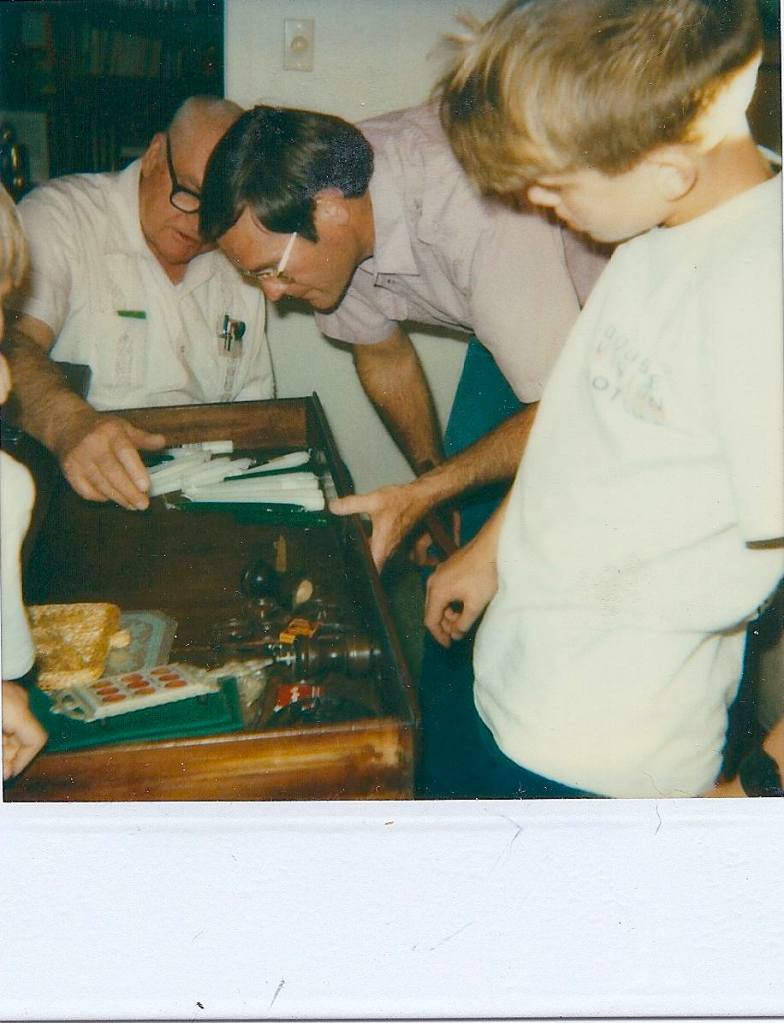
Inside the large wide drawer in the low boy/high boy is displayed a list of all of the owners of the antique furniture. Among the names in that drawer are three names I knew personally. My father-in-law, John C. Shreve, known as Jack, was a proud owner and, due to a determined older sister and also an aunt, Jack received the low boy/high boy when he was of legal age. His father and mother had died when he was only 13 years old in 1927. He was not of age to have possession of his inheritance. Jack made a big deal out of putting his oldest son’s name in the drawer as the next owner. I have a picture of Jack showing the names in the drawer to John, Jr. and John’s oldest son, Aaron Shreve.
I have been playing at genealogy for years but have not gone much further than the low hanging fruit. This antique fascinated me and I decided to research all of the names in the drawer. Due to some errors in the Shreve family tree that I made some previous 20 years ago, I was unable to make the proper connections. Out of the blue, I received a beautiful thick book on Shreve genealogy from John’s second cousin Tim Upson. With his accurate tree, I was able to correct mine and make some more connections. Thus I am now attempting to trace the travels of high boy/low boy from the 1700s to present day.
The first name and original owner was David Stockton. Parenthetically, I am writing this in Stockton, CA, named for a member of the Stockton family. David was born in 1730 in Burlington, New Jersey. His parents were John Stockton (1674 – 1745) and Ann Knott Kendall Ogborn (1687 – 1745). The family were Quakers and had been in this country since 1618. David married Elizabeth Ireton in 1761 in Burlington, New Jersey.
David and Elizabeth lived under a Royal governor who was appointed by the King of England. During the American Revolution, David was one of the one third of people in the New Jersey who supported the rebel movement. Another third supported the king and the last third was neutral. David was a Captain in the Rebel army and in charge of the 6th company in a battle of April 5, 1778. This seems interesting in that David was raised Quaker who are against military actions. David’s death date is up for debate but I do know the low boy/high boy left his home and was handed over to Job Stockton in 1791. The year 1791 also was the wedding date of Job.
Job Stockton was not the first son of David and Elizabeth. However, he became the next owner of the high boy/low boy. Job was born and then married in Burlington, New Jersey. Job married Nancy Ann Ridgway in 1791 and also came into possession of the heirloom. They had four children, three sons and then a daughter Mary Ridgway Stockton. Mary ended up with the furniture items and when she had possession can only be guessed. There is a huge gap in the dates in the drawer. The first date is 1791 and second date is 1893 with Emma Shreve’s name in the drawer. Emma was the daughter of Mary Ridgway Stockton. Mary became a Shreve when she married Samuel Shreve in 1826.
Emma was a twin with Lydia and they were born in 1839. Neither twin married so I was so curious how George Wilkins fit into the picture. Emma and Lydia lived with their sister Phoebe Virginia Shreve who married Abel Wilkins. In the 1880 census, Phoebe is listed as a widow and living with her 12 year old son George and her twin sisters.
When Emma died in 1893. Her twin sister Lydia was the executor of her will. Her surviving siblings were also listed: Sisters Lydia and Marianna Sharpe plus brothers Benjamin Shreve and George Shreve. Phoebe was already deceased but her son, George Wilkins was still alive. George was given the high boy/ low boy. When George Wilkins died, his widow divided up his estate and it became a lawsuit. After the lawsuit was settled, a first cousin of George, John McJilton Nelson Shreve gained possession of the prized furniture items.
John Nelson McJilton Shreve was born in 1881 and died in 1927. He received the high boy/low boy in 1915. At this time John had married his wife, Adele Carstensen and they were a family of five with two daughters and one son. They were living in Scarsdale in Westchester county in New York. The furniture items must have felt right at home at this location as it was full of servants and high society type guests. In 1927 John and Adele had fallen on some hard times due to the slow market just before the crash. They had traveled to sign a contract for a deal involving copper and were looking forward to a nice turn to a much better financial future. Alas, they ran into the back of a truck that was stalled on the dark highway on the way home. They both died and the household was thrown into disarray.
The oldest son was John Carstensen Shreve. He was 13 years old and remembered leaving a pot of coffee on the stove for his parents when they returned home. John found the coffee pot unused the next morning and knew something was wrong before they received official notification. John had a young brother Nelson who was eight. The two older sisters had already left the house as adults. The estate was going to be sold with all of its contents. Two different families stepped up to take in the young Shreve boys. John Nelson McJilton’s sister, Mary Ridgway Stockton Shreve Fisher, came forward to buy the high boy/low boy so it would stay in the family. The oldest sister of John, Adele Kennerly, got involved and proclaimed that John, known as Jack, should be the next in line. Then it was agreed that Aunt Mary could be the trustee of the furniture items until Jack became of age and had a residence in which to keep them.
Aunt Mary Ridgway Stockton Shreve Fisher was in possession for twenty-two years from 1927 until 1949. In 1949 sister Adele of Jack paid $75 for the transportation to have the furniture items moved to Jack Shreve. Interesting enough is that Aunt Mary died in 1950 and the destiny of the high boy/low boy could have a much different route if Adele had not insisted on it going to her brother Jack. Jack was career Army and the furniture items moved all over the world at his various assignments. The possibilities of all of the moves are remarkable because the precious furniture is in rather good shape.
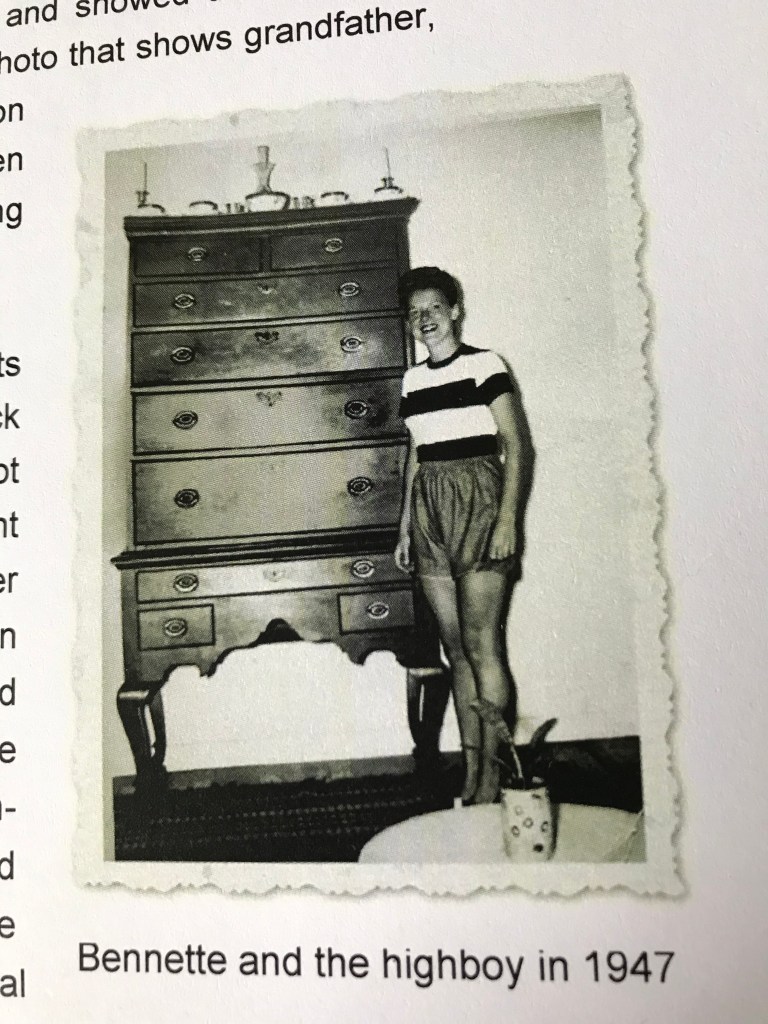
Jack first received the family heirloom in Savannah, Georgia in 1949. At this time he was married and had two children. After, the now family of five, they moved to Dothan, Alabama. Soon they were on to Fort Sill in Lawton, Oklahoma. Then the family went to Okinawa in Japan. It was here the family expanded to four children. After several years, the family and furniture items moved to Stockton Field Annex in Stockton. The family stayed at this location the longest as a whole unit of six. Then it was on to Germany at Kaiserslautern and Kitzingen. Finally the family finished the last assignment and retired in El Paso, Texas. Here, the high boy/low boy resided for an extended time for this family. Jack died in 1995 but the furniture items did not leave ElPaso until Jack’s wife died in 2010.
By this time, the next recipient almost did not receive the heirloom. Younger brother Nelson, known as Mack, had two alternate plans. The first plan was to get support from the other siblings, Adele and Mitch, to demand the items be sold and the proceeds be divided among the four siblings. The items had been appraised by Sotheby for quite an impressive amount. Adele and Mitch would not agree to Mack’s scheme as they said it was always known John was next in line. Mack then threatened to burn it in the backyard. Fortunately that did not happen either. Mack had estranged his siblings for many other reasons by this point.
John rented a trailer and drove from Stockton to ElPaso to take possession of the family treasure in 2010. He rented a two axle large trailer to give the items the best ride and brought many padded blankets and straps to secure the valuable items for the 1,170 miles journey to its next residence in Stockton, CA. It John’s oldest son, Aaron Carstensen Shreve, has been written into the drawer. Fortunately Aaron has a son so the lineage is decided for two more generations. Possession of the prized heirloom is an honor and a huge obligation. Since being in the family since the 1700s, it is important not to damage the items or to sell them. What a journey so far. Robert Stockton 1791, Job Stockton, Mary Shreve, Emma Shreve 1893, George S. Wilkens, John Nelson Shreve 1912, John Carstensen Shreve 1927, Mary Ridgway Stockton Shreve Fisher in trust 1927-1949, John Carstensen Shreve 1995, John Carstensen Shreve Jr., Aaron Carstensen Shreve.
 Swagerty-Aldrich Family Web Site