
I always had a regular job since I was 10 years old, when I started out as a helper for a newspaper carrier. I had my own route by the time I was eleven. I worked continuously until I retired when I was 62 years old. I haven’t worked since.
I still had my paper route when I started high school. I had to make sure every customer on my route got a newspaper each afternoon, Monday through Saturday. I got Sundays off, but I helped a friend deliver the Sunday San Francisco Chronicle each Sunday morning. I also had to collect the monthly payments for the newspapers from my customers. Near the end of each month, I would visit each house and ask for payment. I had to visit some houses several times before I was paid. I learned that some customers couldn’t pay on the Sabbath, which was new to me. I had one customer that never paid me, and we had to send them to collections. That was a learning experience. It was nice to have the Stockton Record back me up financially with this deadbeat customer. That’s when I learned about welfare and how some people will take advantage of you if you are not careful.
My parents didn’t let me quit my job with the newspaper unless I had a good reason. That’s when I decided I was a basketball player. Basketball practice was after school and conflicted with my delivery of the newspapers. I was unemployed for only a short time. I received an opportunity to be the campus representative to a big department store in the new mall. I was hired and I was soon learning the clothing retail trade. The store had an “avant-garde” clothing section in the Men’s Department. I was to be the hip high school student along with two or three other students from our school. This was the mid-to-late sixties and this clothing section had paisley shirts and bell-bottom pants. I also worked the rest of the men’s clothing section, men’s shoes, and men’s suits. I worked evenings and week-ends and full-time during the Christmas rush.
Each summer, once I was 16, I worked for the Stockton Parks and Recreation as a life guard. I also taught swim lessons. I would teach Red Cross swim lessons in the morning, and then I would life guard the rest of the day. I worked a variety of swim pools for the City. One summer, I was assigned to a swimming pool that was located at an elementary school in the eastern part of Stockton. I was the only employee for the pool. I arrived early in the morning and hosed down the area around the pool. I also began the process of filling the pool. This pool was about two and a half feet deep in the shallow end, and about five feet deep in the “deep end.” The pool was about 30 by 50 feet. I would fill and drain this pool each day. By 10:00, the pool was full of water and swimming lessons began. I would get a lunch break after the lessons, and then I would open the pool to the children of the neighborhood. At about 4:30 or so, I would open the drain and begin the process of emptying the pool. The pool would close for the public at 5:00. It would take another hour or so to finish draining. I would then hose out the pool and lock up for the day.
Working for the City of Stockton as a life guard was my first introduction to life outside of the protected bubble of Lincoln Village. Lincoln Village was a major housing development that was built in Northern Stockton for the post-World War II era. The soldiers were returning home from the war and starting families. Lincoln Village was designed to meet their housing needs. We were one of the first families to move into Association #3. There would eventually be six associations. Each association had its own swimming pool, and life was pure suburbia in the 1950’s and ’60’s. When I became a life guard for the City, I was assigned to the city pools which did not include the swimming pools in Lincoln Village.
One year I was assigned to a swimming pool that was located in McKinley Park which was deep in the southern part of Stockton. The demographics were about 90% black, 9% hispanic, and 1% everything else. It was the first time in my life that I was a minority. It was the first time in my life that I was even aware of race, for Lincoln Village was, for the most part, all white. I never thought of race, because we were all one race. Once, in about fourth or fifth grade, our teacher prepped us for the fact that we were going to have a new student in class the next day. She explained that this student was negro. She then had to explain what Negro was. She did this by pointing out race differences. There was a boy in our class who was from south of the border. I think she was trying to point out that even though we may look a little different, we are all human beings. Personally, I think she did a poor job of introducing us to race. I think most of us would have just accepted this new boy into our class like anyone else, if she hadn’t pointed out that he was so different. The poor boy who got to be the example of what a different race might look like spent most of that next recess trying to explain that he was Castilian and not Mexican. His parents had obviously prepped him about his heritage. The new black family that moved into the neighborhood didn’t last long. Their house was egged and racist comments were spray-painted on their garage door. I wasn’t really aware of this at the time. I just knew our new black student wasn’t part of our class for very long. This was what I knew of race when I was hired by the City of Stockton.
McKinley Park was an area of grassy rolling knolls with picnic tables scattered throughout. Near the entrance was a parking lot that served the park and the swimming pool. The pool was fenced with a barbed-wire top which created an atmosphere of being a compound. The swimming pool entrance was a double-door into the main pool building. This building was made from cement brick and housed the boys and girls bathroom changing and shower rooms as well as the basket rooms and concession stand. You would enter and pay your fee or show your ID. You then turned either right or left, depending on your gender. You were then given a numbered basket that had a corresponding numbered safety pin attached to it. You would go into the dressing room, put on our swim suit, and put your street clothes in the basket. You would then take your safety pin and give your basket to the basket-keeper.
I loved our basket-keeper. His name was Willie. He was a very large black guy who lived in the neighborhood. His official duties was being the basket-keeper, but his actually job was the pool bouncer. If you had any trouble with the swimmers, Willie was there to enforce the rules. It was a tough crowd, and Willie was invaluable.
To give you an idea of the environment of this park, I’ll share what happened the year before I worked there. Every afternoon, the picnic tables in the park became crowded with people who would play craps, drink, and have a good time. Things could get pretty rowdy at times, but it was policed by the park-goers for the most part. This summer, two rookie policemen decided things were getting too rowdy and decided to break things up. Well, this didn’t go over too well with the crowd, and the two policemen were beaten unconscious and their vehicle was overturned. Backup arrived and took the policemen away and had the vehicles towed away. For the rest of the summer, the swimming pool staff arrived to be escorted by a police escort to and from the parking lot to the swimming pool.
Our summer was much more peaceful, but I did have my life threatened twice by unhappy patrons who got kicked out for not following the rules. This completely naive and ignorant teenaged kid got a major education in race, prejudice, and human relations that summer!
Always having a job as a child meant I always had money. I was able to buy gas for the car I owned. I joined the Columbia Record-of-the-Month club and soon had a nice record collection. I had a nice coin collection I developed over time. I was able to go through the coins I got from my newspaper collecting to find some treasures. I also got a nice collection of buffalo nickels by going through the nickels from the high school tampon machines. My dad knew I collected coins and would bring home the nickels for me to go through. I also could buy any snacks I wanted, which was good, being as I had quite an appetite. Always having money didn’t serve me well when I went off to school and became a starving student. I had developed an attitude that money is to be spent. That is its purpose. I have always had a hard time with saving money. After I went to college, married, and had children early, I was always in need of more money. My free spending habits collided with the realities of raising five children on one teacher’s salary.
Having a job early was also an asset for me. It taught me responsibility. I had to be at the corner lot to pick up my newspapers at 3:30 each day. If I wasn’t going to be there, I had to make sure someone else who I trusted was there to do it for me. I also learned the valuable lesson that there are people who do the actual work, and then there are people who supervise and direct the people who actually do the work. I wanted to be a leader who was not afraid of getting my hands dirty, and this worked out well for me.
Brian
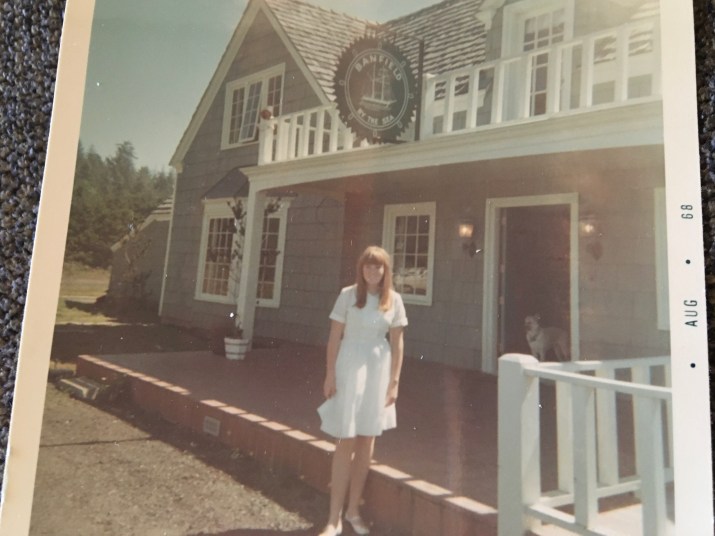

I didn’t really work during the school year except for babysitting. I think I made 50 cents an hour. I made head scarves during high school and tried to sell them at my father’s grocery store. I sold maybe 5 of them. The summer after I graduated from high school, I lived with my Grandma Ober in Banks, Oregon, and worked with her in the strawberry cannery. It was a pretty boring job picking the stems off of the strawberries and throwing the bad ones away for 8 hours a day standing along the conveyor belt. I worked alongside my cousin, Gary’s wife, Patty some of the time. It was good to get to know her. She was deaf but could read lips really well. She was a little hard to understand when she talked but we managed to understand each other. I made a dress for my Mom for her birthday when I was at my grandma’s house to help fill the time. I think the job at the strawberry cannery lasted about 6 weeks.
When I was a freshman in college I was in the work-study program and I worked in the college dining room clearing the tables. In the summer after my freshman year I worked as a motel maid and once in a while a waitress at The Inn at Otter Crest overlooking the ocean near Otter Rock, Oregon. A bonus of the job was its beautiful location. The beach below it is called the Marine Gardens and it is full of marine life.
The summer after my sophomore year of college I worked as a cashier at Snyder’s Market, my Dad’s grocery store. The next summer I was married and preparing to have a baby!

Mary Lou
 Swagerty-Aldrich Family Web Site