by donna Swagerty Shreve

My first teaching job took place in a small town of 3,000 in Connecticut. I arrived June 1968 in Connecticut after being separated from my husband since March. I had to finish my student teaching assignments to complete my teaching credential in California. John had auditioned and been accepted into the official Coast Guard Band that was stationed in New London, Connecticut.
John had found us a one bedroom apartment in a large complex with the fancy address of Nob Hill. That was all that was fancy about it and this certainly was not San Francisco. We had very limited furniture and what we did have was hand-me-downs. Our bedroom had converted apple crates that I had spray painted to use as nightstands on either side of our bed. He had a four year commitment and if we wanted furniture, I needed a job.
My first attempt at a job was in the New London School District. I was directed to the elementary school where there would be an opening for the next school year. School was still in session and the principal started our meeting with a tour of the building. The school had three separate floors with classrooms. The halls were dark and uninviting. The opening was for a fifth grade which was the grade level I wanted.
As we entered the second floor, the principal told me one of the many rules of the school was only one student could be allowed in the hall during class time. We came upon a single black boy who obviously was used to being in the hall and not in class. The principal even called him by name. The fact that the school had such a rule and it was obviously used, told me the principal would not be a good backup if I ever needed help with discipline.
The older (maybe 50s) principal seemed worn out and ready for school to be over. I do not remember much more of the interview as I was having shell shock. The building was in poor repair and the staff seemed beat up and lacking any enthusiasm. The thought of teaching here seemed like a nightmare. Realize I came from a white middle class bubble. I grew up in Lincoln Village which was very segregated. The lone minorities in our class of 1963 was a Korean and one Hispanic. I then ventured on to U.O.P. Again I was surrounded by mostly whites. Because of my cousin playing basketball, I met various black players. I also shared a long car ride with a black girl in my dorm my sophomore year. I hardly had the background for what was happening at this first interview at this diverse inter-city school.
Fortunately I had lined up two more interviews in two other districts. Onward! Now, at least, I knew what job I did not want.
The second interview was in the district of Waterford. The school district and town were located right next to New London and it had a smaller population. The interview went much better as the school buildings were more modern but no specific job was available. There were just possibilities of job openings coming soon.
By the time I got my third interview, the school year was over. This school district was East Lyme which was located next to Waterford and that much farther from New London. The town of Niantic had a population of 3,000 but in the summer it soared to 9,000 with the influx of summer residents who had beach homes along Long Island Sound. The old school was located by the town cemetery on one side and a Harley/Davidson motorcycle dealership on the other side.
The principal was quite energetic and conducted a fun, comfortable interview. The opening at his school was a third grade and I accepted the job on the spot. My room was located in the older section of the two story building. The main floor housed two classrooms for each grade level up to fourth grade. The two fifth grades were located down stairs which also housed the cafeteria and multipurpose room. My classroom was well worn but I was determined to spruce it up before the students arrived.
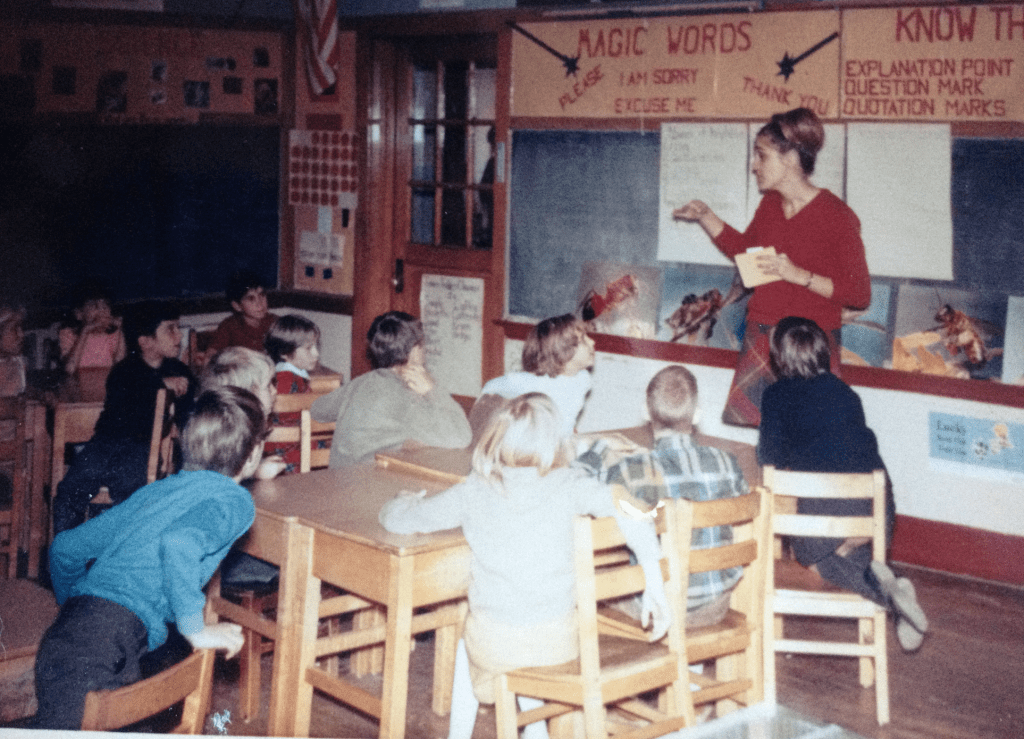
I spent an entire month before school starting the decorating and gathering supplies for the upcoming year. As I gradually met the fellow teachers and support staff, I realized I was quite the oddity. I was from California and most everyone else was from the area and had strong family roots going back generations. “Do you surf?” “Do you have a hot tub?” Isn’t it about two hours from Frisco to L.A.?” In 1968 these were common questions to someone from California.
While I had still some of the summer left, I explored the area. I had met a woman around my age in my apartment complex who wanted to drive around. Her husband took their lone car and I was able to drop John off at his second job at Sears selling electrical products and keep the car. She had grown up in the area so she knew some good places to visit. With her help, I was able to look around the area and get an idea of the culture. I felt a bit more secure walking into my new classroom.
My 23 third graders greeted me. They were at a magical age where they still liked their teacher and were not up into peer pressure yet. I feel I should apologize to that first group of students as I was so strict and concerned about keeping everyone in control. I actually had one student call me on it. She was known as being a bit of a problem as she caused disturbances in class by talking to her neighbors too often. I pounced on her with after-school detention. Her comment was, “I might have been talking too much but aren’t you being a bit harsh?” I realized she was right.
My next challenge was dealing with the parents of my students. I was newly married, 22 year old. Yes, I was the oldest of four and had spent many years babysitting and life guarding but I had not had the responsibility of teaching an entire class. One mother found me in my classroom setting up the room a week before the start of school. She came up to me rather aggressively and wanted to know if I had been warned about her son. I was caught off guard and told her I knew nothing about any of my students and they would all get a fresh start. Wrong answer!
I had been cautioned about her son by the principal and several his previous teachers. Albert was extremely bright but had learning problems and was quite active. His mother wanted me to have a head’s-up about Albert so I would be better prepared. I learned that day a valuable lesson for future encounters. Be truthful from the start. Albert and I shared the same birthday and when John and I moved from our apartment in New London to a rental house in Niantic, we moved right across the street where Albert lived with his mother. I also had Albert for two years in a row as I moved from third to fourth grade and had one half of my first class students again. After I moved back to California I kept in touch with his mother for several years. Albert grew up and became one of the technicians that set off commercial fireworks. He was also a dynamite expert and was used for various demolition jobs in the area.
My favorite memory of Albert was the first Halloween we lived in our Niantic house. Albert arrived at our door dressed as an elaborate tree. To top off the tree look was the nest on top of his head complete with a bird. The detail was amazing and he was quite a piece of art.
My third year I learned the most as a teacher as I agreed to teaching a coaching class, now known as “special ed”. I had a classroom full of students no other teacher wanted. They had all been flunked once and two of them twice. It was quite a year for all of us. After my only year, the concept of the coaching class was dropped and I was given a regular class.
My last year I tried even new ideas. I found Connecticut winters rather grim after awhile. I did not ski and I tried ice skating on the local pond but I was not willing to fall a lot and it really slowed down any progress I could make as I would not take many risks. To help with the winter doldrums, I had John help me build a green house I could put into the back of my classroom. We grew, from seeds, chrysanthemums and loved to use our code saying: “Mums the word.” We were growing the flowers for Mother’s Day. I was able to teach in a time when we were allowed to celebrate all of the holidays in the classroom. We also made bird houses from scratch and the children got to learn how to use a hammer and nails. One of John’s good friends from the Coast Guard Band had a woodshed and he cut out ready-to-make kits so everyone could make a bird house. Of course we researched the proper opening for the available birds in our area.
I had explored the old school building and had found an old incubator. Well, what an opportunity. I went to a local chicken farm and purchased a dozen fertile chicken eggs. That was when we ended up with Buster, our classroom mascot, the Red Island Rooster. He was delightful and when we had to, we helped to find a good forever home for Buster so he would not end up someone’s dinner.
I also ended up with a pair of gerbils. Gerbils are not legal in many states for classrooms as they could survive if let loose. In Connecticut with the harsh winters, Gerbils could be classroom pets. They are gentile and do not mind being handed. I got the cage, food and a male and a female. They mated and delivered a new litter every 27 days. We were witness to this process many times. I remember one time when Albert came up to me to inform me that Papa Gerbil had played piggyback with Momma Gerbil thirty times and then he lost track. Understand that Momma Gerbil had just given birth to a litter of six. Oh, the education opportunities in our classroom! Somehow we were always able to find homes for all of the gerbil babies.
One Christmas vacation I had not gotten a volunteer to take the gerbils home during the vacation. I had them at our home in a spare room up stairs out of the action. I left for shopping and came home to feed the gerbils. When I went to their cage I found out the hard way that the cage was not cat proof. My two Siamese cats had watched them for a while and had figured out how to get in. I was left with a few feet and two tails. I had the difficult job of explaining to the class why we no longer had our classroom pets.
The location of the playground right next to the town cemetery gave us quite an opportunity. We had the family ancestors buried right next to us. I organized graveyard history by introducing certain long standing families that helped develop the town. We then went on a short field trip and did some graveyard rubbings. I cringe now realizing how there are much better techniques used to preserve a grave stone but we were unaware and marched on our merry way. We spread out so we would not duplicate and then came back to the classroom to share our rubbings. We now had dates and names.
We were right down the road from the Thomas Lee House that had been built in 1660. Of course, we visited the oldest wooden home built in Connecticut and learned more of our history. One of my students was in elaborate leg braces and John was able to come with us and carry Bobby in and out of the bus.
We were half an hour by bus to Mystic Seaport which is a preserved seafaring village. There are various people in authentic garb that recreate life during the height of the whaling era. We did another field trip to this treasure to take in what life was back in the day.
I left my teaching in Connecticut on a high note. I had spent four years getting to know the history of the area and decided to write a musical to tell the stories to the students and the residents. I looked around and saw what resources I could use. The neighboring teacher loved playing her piano and her classroom of third graders were constantly singing. They became the chorus for the play. I took well known melodies of yesterdays and changed the lyrics. The piano player had easy access to the melodies and I just had to write the lyrics. One of my favorites was sung to the song “Playmate.” The song had been written in 1904 and evolved into a playground game that was sung with hand claps done with a partner. Playmate, Come out and play with me and bring your dollies three, climb up my apple tree, shout down my rain barrel, slide down my cellar door, and we’ll be jolly friends for ever more. The lyrics were changed to “Luce brothers, shut down your factory, you are stinking up our town, the smell is really getting us down.” I had twin boy students that year and they played the Luce brothers. They were great except when they got the giggles and then the chorus had to pick them up. The Luce brothers’ fish factory actually did get shut down at some point. I can’t recall the other songs but they contributed to the story of the town’s history and got to involve that many more students.

I actually had prep periods way back in 1971-1972. Our art teacher had connections with the local theatre group and he was able to get three worn out canvas sets that we were able to repair and repaint. He used our art period to get the students painting the sets. Unfortunately he couldn’t help himself and added a lot of his talent to insure the sets were professional looking.
Several people volunteered to lend us artifacts for our stage settings. One of the third grade teachers lent us her prized family antique spinning wheel. I remember being quite nervous when the spinning wheel was brought on and off the stage as it was quite a generous gesture on that teacher’s part.
We gave four performances, two were for the school and two were for the parents and the townspeople. We even made programs for posterity. We also made flyers to place around town to advertise our big production. Much to our surprise we packed the auditorium both evening performances. I also had a the help of a student teacher for all of this. I needed all the help I could find with this ambitious project. I was so pleased she was able to get my job when I left.
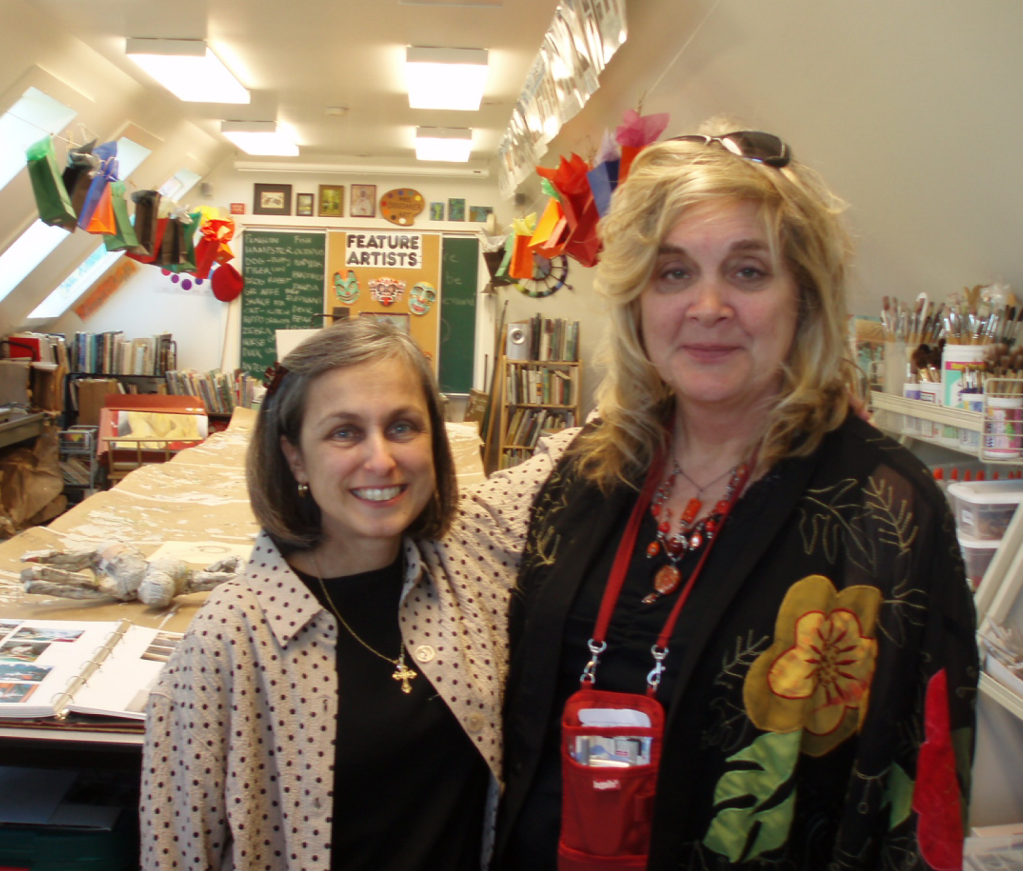
Years later I returned to visit and she was part of a group of four adults who wanted to have a small reunion. She was joined by a former principal, fellow teacher and former student. It was quite an emotional day. We met at a restaurant for lunch and then went to my former student’s home where she ran an art school. I struggled all day not to break down and just cry with joy at their memories. Sophia, my former student still runs her art school to this day. She remembers being in my first and second year classroom. I encouraged her art work and she has never forgotten. She shared artifacts she had saved from her time in my class. I was totally amazed and honored.
During one of my visits to Connecticut, my former principal took me to visit my former school in Niantic. The old section where I had taught for four years, had been torn down. The school had been remodeled and there was little to remind me of my time there. The cemetery was still there but not the Harley shop. Ah, progress! My principal tried to impress me with a new school in the area that was diverse as opposed to what I had experienced. After all, I was from diverse California. The new area school actually had a few black and hispanic students. I recently taught at a school in Lodi where there were seventeen different languages spoken in the students’ homes. Well, it was some progress. I treasure those four years in Connecticut. John and I had some magical years learning to be adults and a married couple.
 Swagerty-Aldrich Family Web Site