by Elmer Swagerty (expanded by Donna Swagerty Shreve)
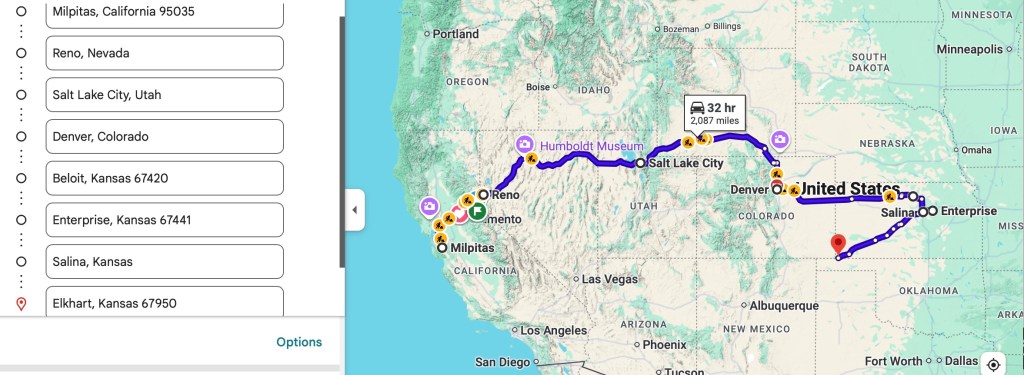
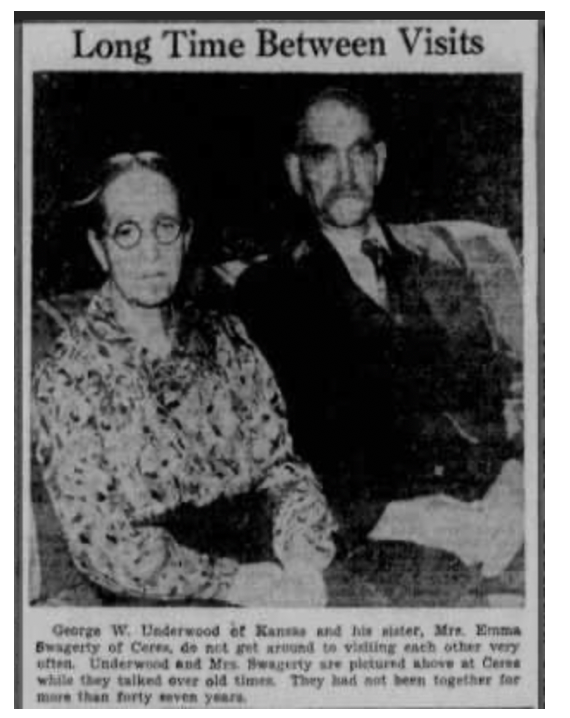
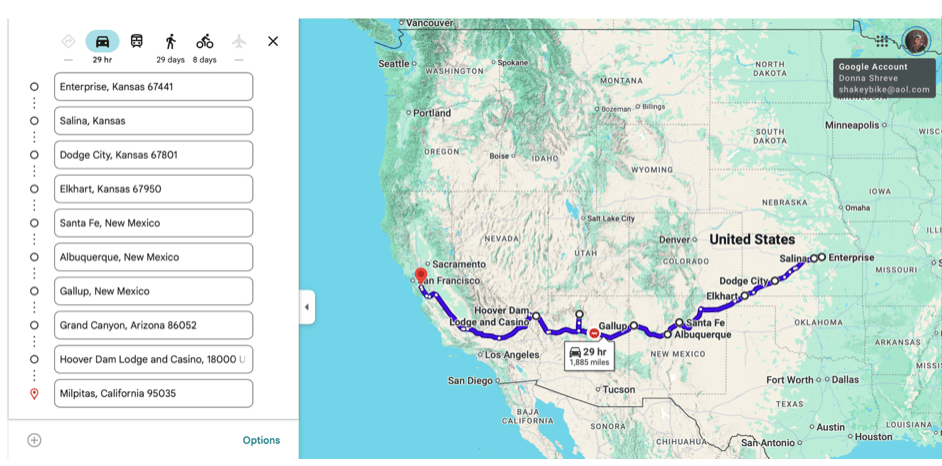
As I keep rereading my grandfather’s poems, I find more interesting facts about the past through Elmers eyes. Based on a Modesto Bee newspaper article about the two siblings that had not seen each other for over 40 y ears,I believe the trip consisted of Elmer’s mother Emma; her brother George; Pearl, Elmer’s wife; and Jack, their son. The tip occurred in 1938. The trip started in Milpitas, California and ending up in Nelson, Kansas.
The following I recorded on one of my visits to see Jack in 2007.
Trip to Kansas 1938
Jack was 14 and getting into a lot of trouble in school. The school officials thought if Jack stayed out of school for six months, his bad friends would move on and he could get a fresh start. Therefore Jack was available to go on the trip to Kansas with the group. (A year earlier, Web had gone with Ida, Abe, and Ethel to Iowa and helped drive. Web was two years older than Jack.) Elmer and Jack got the mantle from the old homestead in Kansas and brought it back with them. They put it in the trailer and hauled it home as a treasure. Elmer made something out of it.
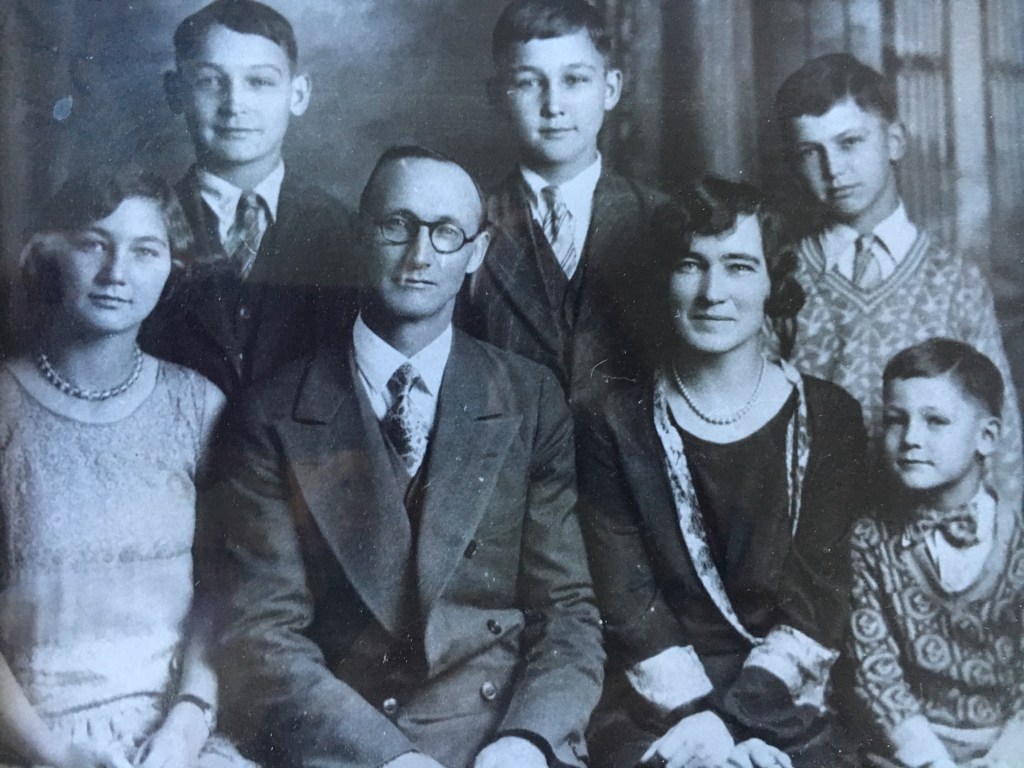
This is Elmer & Pearl’s family in 1930.
The trip was taken 8 years later. Elmer, Pearl and Jack are in the front row.
1.
The pears were gone
To ports beyond
The ladders were in store
The sky’s were gray
The fog they’d say
Vacations here once more.
The end of a typical pear season is August. Pearl, age 42, and Elmer, age 48, probably only had one child at home. Darrell had graduated from high school and was on to College of the Pacific following his older brothers, Clem and Floyd. All three brothers spent their summers working long hours to earn money for college. Football scholarships were only partially funded then. The family was living on the Standish ranch where Elmer was the manager. While the Swagertys lived there, the ranch went through several crops but had pear orchards at this time.
2.
The Ford was fixed
The trailer hitched
And grub was stored galore
The maps secured
The routes we toured
Were studied o’er and o’er.
Elmer never had the latest model of automobile so his car was an older model, and he mentioned it being fixed. My father told many a tale of fixing cars or machinery with whatever they could find. Cars were certainly simpler then, but I doubt they went far without either a flat tire or a mechanical breakdown. Roads were not in good condition and the cars had poor suspension. It had to be uncomfortable ,compared to what we are used to riding in. I can imagine Emma and Pearl making picnic style food to store for eating along the way.
3.
Till when at last
Friends hands we’d clasped
and made our get-away
It was as though
We had to know
Just how old Kansas lay.
The family was quite involved in the San Jose Methodist church and probably had many friends to say their goodbyes. I am guessing that his reference to old Kansas would be the original homestead and many years ago compared to living in California.
4.
The seats were full
That Lizzie’d pull
Just five to be exact
There was one to steer
And one to cheer
And three stowed in the back.
Lizzie was a common name for a Ford motor car and could not have been very large. I know Elmer drove and am guessing at Pearl and Emma’s placement. Logically Pearl sat up front with Elmer and Emma, age 78, sat in back with her brother George, age 70, and grandson Jack age 14.
5.
There’s mother dear
So full of cheer
Who always had a smile
And Jack the rookie
Who loves his cookie
As he crunched them mile on mile.
Pearl definitely was known for her good cheer. Jack, age 14, was in the middle of his grandmother and Great Uncle George in the back. I got to talk to Jack about this trip and he remembers George chewing away on tobacco constantly.
6.
There was Uncle George so very large
And ready with his wit
Who loved to chew
Why no one knew
Because he had to spit
Jack had the horrible job of cleaning the trailer when they arrived in Kansas. Most of what George spit, ended up along the side of the trailer. Jack said if it had been up to him, he would have burned it. Elmer had built the trailer out of plywood and needed it to haul items back on their trip plus store their luggage, food, and bedding.
7.
And Grandma too
With dresses new
All piped up for the trip
Old friends to trace
To see their face
And give their hands a grip
Thanks to my cousin Nancy, I now have my grandmother Pearl’s foot treadle sewing machine that I am convinced was used to sew both Emma and Pearl’s dresses. Emma and Pearl could do all of the crafts women of their day were expected to do. Emma left Kansas in 1882 with one child and her husband. Her parents and siblings were all in Kansas when she went off to California to have a total of nine children who survived a marriage of over fifty years. It would be quite a homecoming. The trip was also delivering George back to his family.
8.
And dad was there
To furnish fare
And steer old Lizzie through
To make the trip without a slip
The way he loves to do.
Elmer loved to be in charge and I was amused by his own self description. Furnish fare, I believe, refers to Elmer hunting game along the way for meals.
9.
We rolled along
A merry throng
As mile on mile we’d drive
Just buying gas
In towns we’d pass
To keep the thing alive.
There were few road side stops or accommodations. Food was stored and money was tight so gas was the main expense.
10.
In Reno of course
We sought divorce
Just why I hardly know
For to make the trip
We daren’t slip
Or get careless with our dough
Stopping in Reno gives me a clue to their route. I do believe Elmer is trying humor at the mention of divorce as he and Pearl had a long marriage only ending with Pearl’s death. Interstate highway did not get built until 1956. Route 66 was established in 1926 but it was farther south from Reno or Utah.
11.
So we passes it up
As a bitter cup
The gambling joints to see
But once in sight
Wife wouldn’t alight
So to travel we did all agree
Based on many family stores, I am guessing Emma would have been in agreement with Pearl on the issue of gambling. George would have been curious and so would Elmer. Jack was too young and the women ruled.
12.
Now the sky’s were still gray
And it rained all day
As the desert haven sight
400 miles that day
Put us well on our way
By a tank we made camp for the night.
That trailer must have been packed with tarps and sleeping bags plus suitcases and food. Roadside stops were rare and camping was much more common. Elmer probably also had his shotgun for protection and finding dinner.
13.
Let the night wind blow
Where the cactus grow
And the lone wolf’s prone to roam
We slept all night on our air bags tight
And dream’t of the loved ones home.
I was surprised at air bags. Somehow that seemed like a luxury they would not have.
14.
For days we drove
And hard by jove
Old Kansas for to see
Across the plains
And mountain chains
And lands without a tree.
John and I drove through Kansas in 2009 and I couldn’t believe how flat the land was for endless miles. There were no trees and a silo became an exciting sight.
15.
Through cities too
Though they were few
Just two to be exact
The first you know
Was Brigham’s show
Where wives they didn’t lack.
Elmer mentions Reno, Nevada and now Salt Lake City, Utah. From Reno to Salt Lake City still is a vast stretch of empty land.
16.
Till Uncle Sam
Dealt out his hand
And did to all decree
To have more wives
Just simply could not be.
Elmer certainly had his opinions on various social issues and here he is commenting on the issue of polygamy. I believe he was quite tame on the issue as I am aware of stranger opinions on other social issues.
17.
And Denver say
We’d drove all day
The rockies were no more
We paid our fare
And camped right there
Its beauty to explore.
Camping along side of the road was not always the best option. An actual camp ground would provide showers and restrooms.
18.
The fields were green
The trees they’d seem
To make us think of home
The place we love
Thank God above
Why did we ever roam.
19.
Then on our way
The following day
It all just seemed a dream
The prairie dreary
And us all weary
No end so it would seem.
20.
Then boy! Oh, boy!
And ship ahoy!
Just make our anchor fast
We saw the sign
We’d crossed the line
Old Kansas here at last.
21.
Now folks don’t shout
No use to pout
This land we came to see
Here they raise grain without much rain
You seldom see a tree.
Elmer has spent all of his life in either California or Oregon which has rich farm lands. Kansas must have been a bit of a shock to realize the limits of the land for various crops.
22.
The people there
Don’t seem to care
There worries are but brief
If crops should fail
They’s simply take relief.
The Agricultural Adjustment Act of 1938 had been passed in February of 1938 and provided farmers with help buying equipment and relief when crops were bad.
23.
Of course there’s some
Not prone to bum
Good folks you’ll all agree
They work real hard
To earn their lard
There from my family tree.
At this point in Elmer’s life he was working for Mr. Standish managing his ranch in Milpitas. The job came with a house and the family was taken care of without much sacrifice. Elmer did not own his land yet.
24.
First my Aunt Belle
We had a spell
We thought we saw a ghost
By our good grace
T’was Lucy’s face
But she was on the coast.
Elmer’s Aunt Belle was Emma’s younger sister Mary Belle “Daisy” Underwood 1870-1944. She went to school in Oregon and became a school teacher. she never married. I posted Aunt Belle’s picture along side Lucy Lillian Swagerty Morris, Elmer’s sister who was living in Ceres, California in 1938.
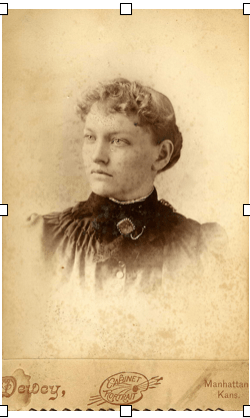
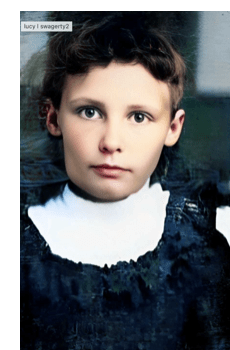
Lucy Swagerty Morris
25.
And Howard too
We could construe
A likeness of some sort
To E. Hoffman of Washington
Once harbored in our port.
Ernest Hoffman was the son of Mary Elizabeth Swagerty Hoffman 1845-1927. Ernest (1887-1971) was born in 1887 three years before Elmer. I have a letter from Ernest to Elmer responding to Elmer’s letter. Elmer wanted to include his cousin on their trip but Ernest was unfortunately going to be out of town and unavailable during the dates Elmer sent.
26.
Then near Beloit
We found the scout
Clif Underwood that’s right
We had a sup
Then got right up
And drove with all our might.
Clif Underwood must be a cousin but I have not found his connection.
27.
T’was George you know
For home would go
His loved ones to caress
Concordia say
Was his wife gay
When she landed that new dress.
In 1938 George was now married to his second wife. His first wife Sophia Kester married him in 1895. They had six daughters and three sons, Sophia died in 1921. George then married Myrtle America Hurd in 1922. George was 54 and Myrtle was 46. Myrtle lived long after George died in 1949. Myrtle died in 1975 at age 101.
28.
Near here we met
Mother’s sister Net
A farmer she had wed
We spent the day
All felt quite gay
Then back to town we sped
Sister Net was Alice Annette “Nettie” Underwood, a younger sister(1874-1954). She married George William Jones (1868-1941) in 1897. They had five children and their daughter was Nellie Mae Jones Maginness (1904-1992)
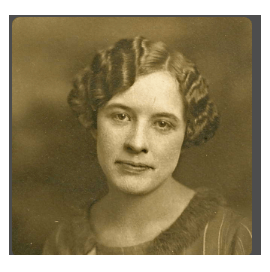
Sister Net (Alice Annette “Nettie” Underwood)
29.
Her daughter Nell
Who feeds quite well
Put on a chow next night
And all was there
To share her fare
She sure did things right.
Nettie’s daughter was Nellie Mae Jones Maginness (1904-1992) She was married to Le Roy Maginness. Her obit said she was owner and operator of restaurants in Concordia and Miltonvale. She was a member of Concordia Wesleyan Church. Obviously she made an impression on Elmer with her food.
30.
Then on we went
Where the Hoffmans rent
A place near one they own
From here we found
Dad’s stomping ground
And his cabin made of stone.
Sampson Clayton Swagerty (1851-1931) lived in Grant, Riley Co., Kansas before he left for California with his then immediate family. Somewhere I have a photo of Pearl, Elmer and Jack in front of the fireplace of the old homestead.
31.
We also found
Grandfather’s mound
It seemed so long ago
Since he was there
Dad’s love to share
And see the country grow.
Sampson and family left Kansas and went to Fresno, California some time after 1880 and before1882. This trip to Kansas was seven years after Sampson had died in 1931.
32.
Now Will’s some host
He had the most
Folks gather in that night
The place was small
To hold them all
They sure were packed in tight.
This Will (1890-1960) was Elmer’s first cousin. Will’s father was William Aran Swagerty brother of Sampson Swagerty. Will was married to Ona Pearl Eastlick. They had at least five children by 1939 and
Will’s mother was still alive. The house located in Elkhart, Morton county, Kansas.
33.
One more jaunt cast
Another feast
Was Mary Gaden glad
For she knew Ma,
And she knew Paw,
When he was just a lad.
I did not research Mary Gaden but I am guessing she was a neighbor from long ago. Manhattan, Kansas is the county site where I was able to find many records when I traveled to Kansas in 2009.
34.
Manhattan whoa
We dare not go
Beyond your pearly gate
For if we do
My boss might stew
Should I come home too late.
Visit with Jack Swagerty 2007
Standish Ranch turning into pear orchards.
Allen was the son of Miles Standish, owner of the pear orchard that Elmer managed in Milpitas, CA. Allen was about the same age as Dad(Elmer).
Allen graduated from Stanford University and was heavy into the redwood operation. Miles Standish was a partner with Hickey and there is a state park named Standish-Hickey State Park. Dad and we would go to the Standish-Hickey State Park area to go hunting. We went to the south fork of the Eel River, which was part of their property. They owned all of those sections of land and had Southern Pacific tied up supplying them with redwood ties. The railroad owned a lot of redwood property but it was too expensive for them to move their equipment around all of the time so they contracted with Mr. Standish and Mr. Hickey to supply them with the redwood for the railroad ties.
Southern Pacific then did research and found they could use pine and oak and treat them with creosote. It was cheaper and the spikes didn’t get loose in the pine where, after a couple of years, the spikes worked loose in the redwood and it caused maintenance problems. That killed the business then.
Miles Standish had all of that property of about 640 acres so he took out the redwood trees and put in pears. There were two 100 cow dairies on the property. One was on one side and one was on the other.
I then asked, “Was that where Elmer learned how to run a dairy?”
Jack replied, “He never learned how to run a dairy.”
35.
So face about
the southern route
You don’t need sympathize
There’s plenty more
Yes kin galore
Some lived at Enterprise.
There is a tiny town called Enterprise in Kansas that is on the way back toward home.
36.
His name was Tom
But if a bomb
Exploded in his ear
He’d brush his face
And then say grace
Because he couldn’t hear.
Visit to Kansas
This is part of an interview I had with Jack in 2008.
This visit was in New Mexico among the Hopi Indians.The Indians got their water out of a cistern. This was the time when the U.S. Government was trying to get the Indians to bury their dead. The custom was to take a severely sick person out away from the village and let them die among the rocks. They didn’t want the bad spirits in the village. The Indian Affairs Department was trying to get them to bury their dead for sanitation purposes. The Indians wouldn’t comply so the Indian Affairs Department came to Tom Swagerty who was with an Indian woman. Tom would go out and bury the dead. Soon the Indians came to Tom to bury their dead as they wouldn’t do it and they knew he would. I don’t know how they made their living. They didn’t have much and they grew some vegetables. This was a town in Kansas that is a bit of a tourist town now. It is called Grant. Their small house had a dirt floor. Tom was almost completely deaf and it was hard to communicate with him.
37.
Tom Swagerty
A blacksmith he
Whose trade had served him well
He bought a place
And changed its face
I think he’s doing swell.
There is a history of blacksmiths in the Swagerty family. Isaac and Sampson were both blacksmiths. I am not sure where Tom Swagerty fits into the family.
38.
Salinas right
We stopped all night
With Gladys Durham neat
Then on to Dodge
We did not lodge
Just had a bite to eat.
39.
T’was Irma Page
Who married age
We talked about an hour
Then did depart
For rare Elkhart
Where Will took care of power.
40.
Will Swagerty
Cousin yesserie
Father’s brother’s son you know
When dad came west
Well I’ll be blest
Ann settled there to sew.
Will was Elmer’s first cousin as Will’s father was the younger brother of Sampson Clayton Swagerty. William Isaac Swagerty(1890-1960) was living in Elkhart.
41.
Now the sky’s were all gray
And it rained next day
Aunt Addie was our host
She seemed so spry
Yet time don’t lie
Eight children she could boast.
I kept looking for a relative with eight children on both sides but couldn’t find Aunt Addie. Seeming spry possibly means she was older but in good shape.
42.
There’s Ben and Will
What another thrill
For a likeness we could note
Although quite large
Upon Will’s barge
Was Wilber plainly wrote.
Ben and Will are sons of William Aran Swagerty (1854-1930) and Nancy A. Gaden (1870-1941)
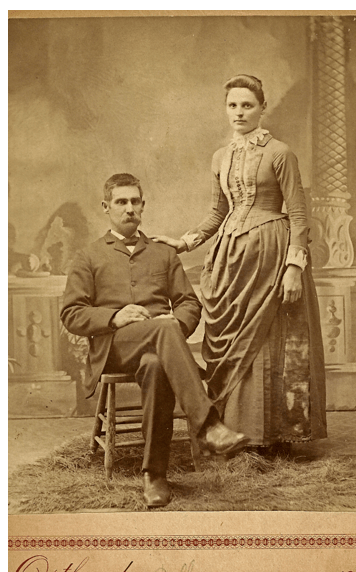
William A. Swagerty & Nancy Gaden
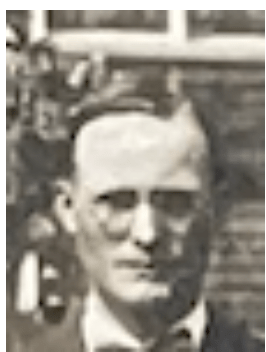
Isaac Wilberforce Swagerty in 1927
43.
Six girls there were
Two still with her
Quite happy were the three
They did their best
To please their guests
As you could plainly see.
The four travelers are now in western Kansas in Elkhart. Uncle George has been delivered to his home in Nelson in Cloud county Kansas before they started heading back.
44.
Then hit the hay
Now why do people roam
For e’r dawn came
Right through the rain
Another girl came home.
45.
And God bless you
The Trimbles too
They had no place to sleep
Was that some plight
Right in the night
We almost thought to weep.
46.
But err tears fell
We broke the spell
Our trailer we did spy
For it was fixed
For just such tricks
A place for all to lie.
In my interview with Jack, he mentioned he slept n the back seat of the car. Therefore the trailer needed to accommodate three adults, Elmer, Pearl, and Emma.
47.
When we awoke
The storm had broke
The sun was in the sky
So we took heart
And did depart
To all we said good bye.
48.
The roads were wet
And slick you bet
It made old Lizzie slide
Down through a wash
And stuck by gosh
It surely was some ride.
49.
In Kansas no
Its New Mexico
Across the Okie, line
By putting wood
He earns his food
This final kin of mine.
From Elkhart, they went through the Oklahoma Panhandle, and into New Mexico.
50.
Another Will
A Swagerty still
Tom’s brother I do fear
He looks like Tom
Explode a bomb
And neither one could hear.
51.
Had a homestead they
That raised no hay
And neither did they mine
This Stewart man
His wife of tan
They gathered pinion pine.
Based on my interview with Jack, the wife of tan was a Native American. Jack remembers the floor in their home being hard dirt.
52.
A home they had
With walls of clay
The sides were built of stone
With children two
And neighbors few
They lived somewhat alone.
53.
But happy say
They seemed quite gay
They had nothing to regret
Their homestead clear
Their patient near
They’ll make their way you bet.
54.
Now this dear guests
Doth end our quests
For kinsfolks we should know
So on our way
We dare not play
T’is homeward we must go.
55.
Through Santa Fe
To Albuquerque
And Gallup what a throng
Of Indian faces
With pottery vases
Our journey they did prolong.
56.
We thought to snap
Their ugly map
Just for a souvenir
But hide their faces
Till we bought vases
They certainly did act queer.
57.
Now folks prepare
For something rare
A desert dawned with paint
With rocks piled high
All smeared with dye
It surely did look quaint.
58.
But why stay here
Grand Canyon’s near
We’re anxious to behold
Its chasms deep
Its banks so steep
Made by the river bold.
59.
Just take a look
Then write a book
Its wonders to explain
Gray hairs will come
Err that book’s done
You’ll find it’s all in vain.
60.
So I’ll not try
To please your eye
You’ll have to go and view
Its grandeur rare
If you should share
The picture as I do.
61.
So on to Boulder
Where they holder
Water mile on mile
It’s the largest dam
In Uncle Sam
It certainly is worth while.
The hoover Dam was originally referred to as the Boulder Canyon Project during its early planning and initial construction phases, despite being built in Black canyon. The name was officially changed to Hoover Dam in 1931, switched back to Boulder dam in 1933, and officially restored to Hoover Dam in 1947.
62.
They took us through
The tunnel new
The power house if you please
Where they made juice
To fry your goose
And light Los Angeles.
63.
The flagpole’s there
But placed just where
We did not chance to see
A stately pole
Yet not a soul
Remembers where t’would be.
64.
Now the skies were still gray
And it rained next day
Towards evening it did pour
T’was tough that’s true
But we drove right through
Hurrah our journey’s o’er.
Back to StoriesStories
Back to Swagerty/Aldrich StoriesSwagerty/Aldrich Stories
 Swagerty-Aldrich Family Web Site