1851 – 1930
by Donna Swagerty Shreve
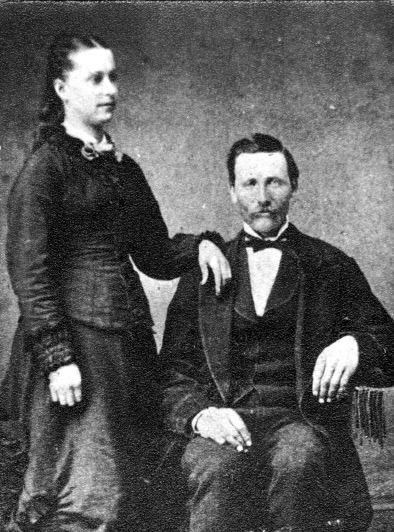
Various mind games come up where you imagine different scenarios. One such scene would be you sitting down with some ancestor and asking questions. If I were given that choice, I would request time with my Great-grandfather Sampson Clayton Swagerty. Many of the records mention him as Clay. Most of my stories came from my grandfather, Clay’s second son Elmer. Grandpa loved to share the stories of his father with me as we chatted on Tuesdays in Escalon in 1972. I have heard these same stories from other relatives as Elmer told the stories of his father on many occasions. Why did this man generate so many stories? Also I am fascinated by that time in history. I believe various historical events shaped Clay into a strong, sensitive and practical family man.
Born in 1851 in Benton, Arkansas, Clay was his mother’s seventh child and his father’s third. His mother, Mary Ellen Stephens, had been married to Pleasant Swagerty but he died by age 30. She then married the younger brother Isaac and had four more children with him. By 1862 Benton, Arkansas was embroiled in the Civil War. As an eleven year old Clay became an active helper to his father on their 160 acres. Isaac supported his family as a blacksmith, farmer and Methodist minister. On day in July of 1862 a Confederate scout stopped by Isaac’s farm and told Isaac the army would be following soon. The confederates expected him to join them as a blacksmith to keep the army on the move. Isaac was handed some Confederate money and told to gather up what supplies he would need. (My grandfather remembered playing with Confederate money as a kid.) The Confederate scout was assuming too much. Isaac had no interest in becoming a traveling blacksmith nor was he a Confederate sympathizer. His farm had a house full of children and employed several laborers. I am guessing he had at least four children left. Mary would have been 17 followed by Pleasant at 16, Clay age 11 and William was about 8. Isaac had the group gather up supplies to last a few days and quickly hid in a large haystack nearby.
The Confederate soldiers arrived but unfortunately so did the Union soldiers. A battle raged several days with the family slowly running out of supplies. This “skirmish” became a prelude to the Battle of Pea Ridge just a few days and miles away. The battles noises stopped after three days and now Isaac needed help. He could not go out himself as either side could easily mistake him for the enemy and shoot him. His wife or daughter could not be a choice as the soldiers were known to rape and pillage. Pleasant Jr., now 16, could have the same problem as Isaac being mistaken for an enemy. That left eleven year old Clay.
Isaac instructed Clay to crawl out of the haystack and go looking for soldiers in blue uniforms. The preferred choice would be to find a soldier on a horse as that could possibly mean an officer. Clay witnessed the destruction of the family home, killed livestock and hundreds of dead soldiers littered throughout. Clay found two soldiers on horses and delivered his father’s plea. The officers returned with the eleven-year-old child and fed and sheltered the family. I am guessing the family was served some of their own animals slaughtered by the soldiers.
I heard this part of Clay’s story from his son, my grandfather. Clay witnessed such a horrific scene that he was affected for life. The Union soldiers had built a stockade in Benton for all Union sympathizers. The family sheltered there until the army could escort them to new land in Kansas. Isaac had lost so much and now was starting over at age 33 on undeveloped land in the brand new 34th state of Kansas.
I heard a story from a descendant of Mary Swagerty that several of the hired hands were hidden in the bottom of the wagons as the family traveled to Kansas. The farm workers had no interest in being conscripted and hid from the soldiers successfully on the journey. Mary ended up marrying one of those workers, Phillip Hoffman. Upon his arrival in Kansas, town people were amazed by how quickly Isaac built and established his new farm.
My grandfather told me other stories about his father and the next story took place in Kansas before Clay got married at age 27. Grandpa told about his father being an early teamster. Clay and his brother, who I am guessing was William as he was the closest in age, earned money by transporting goods from Kansas to Arkansas and back again. They established a workable routine where they earned money coming and going. They usually transported flour from Kansas to Arkansas and stopped at a certain farmhouse along the way. If they gave some flour to the farm wife, she would make a big batch of biscuits for the rest of their journey.
Another story from this period in Clay’s life was how Clay and his brother William would hire an Indian scout to help them hunt. This guide was very particular whom he would agree to help. He demanded two rules. They were never to camp by a river and after dinner, the campfire was put out. This was a time of renegade Indians who attacked easier targets. On one hunting trip, the brothers were camped up a hill that overlooked a river. There a small group of hunters camped by the river and were feeding a fire well into the night. The next morning the brothers and guide went down to investigate and found several murdered bodies and most of their supplies missing.
Clay was also a deputy sheriff in Dodge City, Kansas before he married. Into town rode a huge black man who cast an imposing figure. The stranger guided his horse to the town’s water trough. There was a line of people waiting and the stranger must not have felt like waiting. He pushed the crowd away and took his turn. The story goes that Clay was also a sizable man and went up and hit the stranger with a wide board and then dumped him into the horse trough. I don’t know if Clay did this in his capacity as a deputy sheriff but it is another story that has been passed down through the generations.
In 1878 Clay married Emma Jane Underwood. Within a year they had started their family with the birth of Mary Belle. Soon Emma had lung issues and they were told, by her doctor that they needed to move to a better climate such as California. By 1882, the family had moved to Fresno, California where Lucy Lillian was born. George Harlan, known as Harley, followed in 1884. Another son was born but he did not live past two years. I have heard rumors of another baby boy dying next but I have no evidence. Ernest Elmer was added in 1890. Quickly Isaac Wilberforce joined the family and was known as Wilber. During this time in Fresno, Clay was a farmer and blacksmith. He made a large bell for the local church and there was a disagreement over payment. The church thought Clay was donating the bell and Clay expected payment. Also around this time the family home burned to the ground. The children born during this time in Fresno lost their photos in that fire. The family then moved to Josephine County, Oregon, after too many setbacks in Fresno. By 1900, the family was living in Grant’s Pass. The last two children, Helen and John, were born in Oregon. Clay and his sons earned a living in the orchards and lumber business. Sometime between 1910 and 1920 the family returned to California. One story came out that the family hoped the move to California would break up their daughter Lucy’s relationship with her boyfriend. To their dismay, the boyfriend followed and Lucy married the guy.
Another story from my grandfather, recalled a hunting trip Clay took with several of his sons. Clay did not bring a gun. After the guys had been hunting a bit, one of the sons tried to tease his father about not wanting to be upstaged by their gun skills. He calmly took one of the son’s guns and proved himself an excellent shot. After his impressive demonstration, he replied he had seen enough killing in his life and didn’t need to do any more.
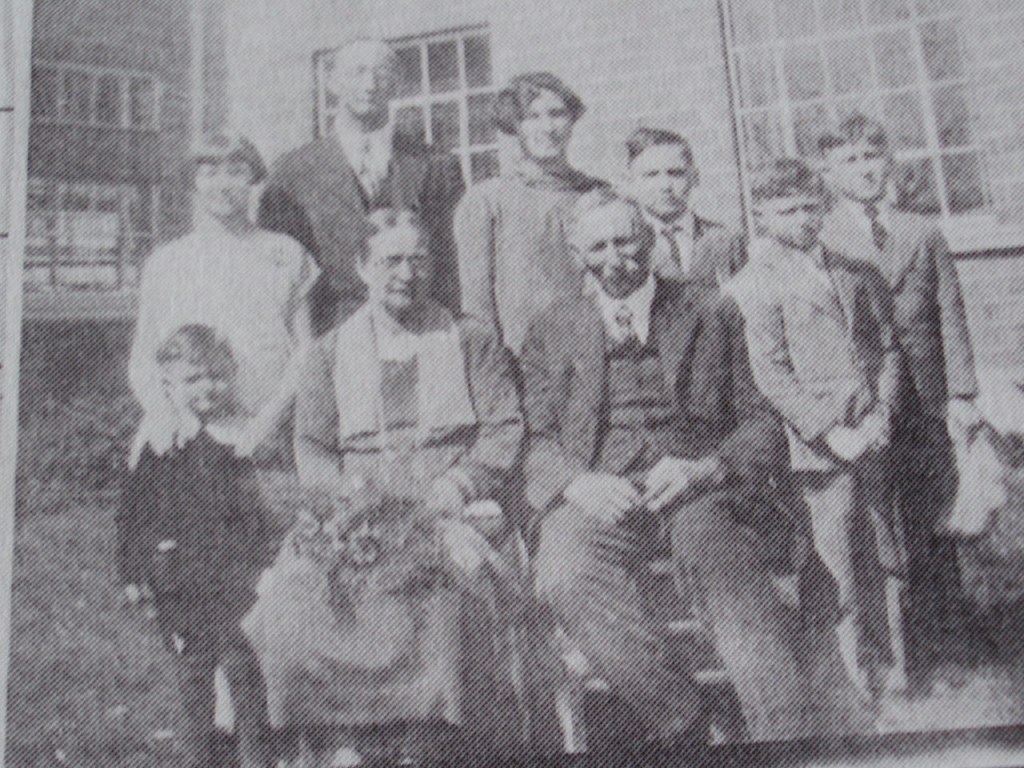
Back in San Joaquin County, Clay built his last home and water storage tank and tower. Clay’s youngest daughter Helen had her bedroom under the water tank and remembers needing a bucket for a constant leak. During farming routines, Clay fell off a wagon and broke his hip. He spent the last eleven years of his life using a crutch to get around. Clay and Emma celebrated their 50th wedding ceremony in Hughson in 1928 and there are wonderful family pictures of all of their children with their families. Two years later Clay died and was buried in the Escalon cemetery.

In 1977 I witnessed quite an argument between his youngest daughter Helen Swagerty Hunter and her niece Zelpha, who was only a year or two younger. Zelpha insisted his name was Samuel and Helen argued his name was certainly Sampson. Helen felt, as his daughter, she would know better. I verified a few years later when I visited his grave. Stories that get passed down from the generations can get a little distorted. The stories that get passed down can change some, but a quality of the man shines through. I really would enjoy having him tell me his life stories.
Through the years these are only stories I remember hearing but I am sure there are more tales if I could only get to the right people who are still alive who can tell them. Somehow all that I have heard about this man intrigued me and I want to know more.

 Swagerty-Aldrich Family Web Site