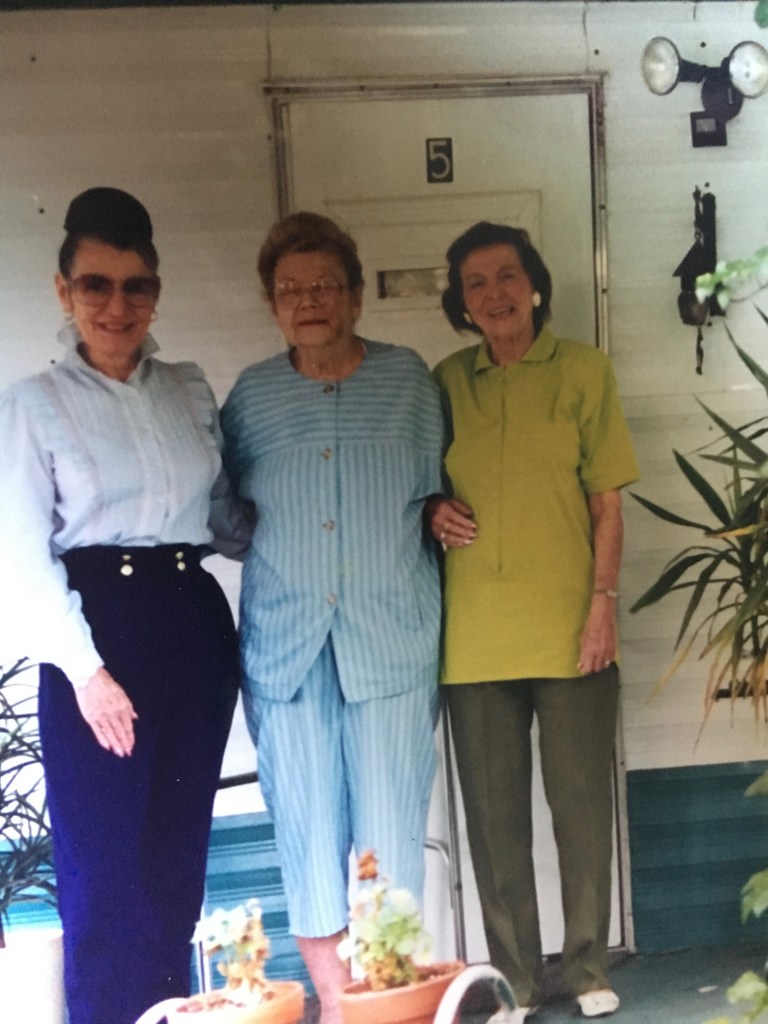
1994 taping for Lillian and Marian
by Donna Swagerty Shreve
In 1969 I traveled with my husband to meet relatives on his mother’s side of his family. Before we left on our trek from Connecticut to Georgia, my parents tried to give me a few tips about southern culture. Dad had been stationed at St. Simon’s Island, Georgia for part of the war. They mentioned a few incidents from their short stay but I was still in culture shock when I encountered the south during my week long visit.
We stayed with Lillian Herrin, John’s mother’s sister in Savannah, Georgia and got to visit and meet with Grandpa Waters, John’s grandfather, and Lillian’s oldest sister Marion. We also visited with cousin Ray, son of Marion, Uncle Dan, younger brother of Grandpa Waters and Grandpa Water’s sister Ruby. At the time I was just meeting relatives and participating in polite conversation. Now many years later I have a better understanding of the people themselves.
Billy Herrin , oldest son of Lillian (1917-2009), taped his mother and Aunt Marian (1916-1995) on July 30, 1994. The tape recorded was set on a coffee table in front of them and then he asked them to remember the old days. Unfortunately I listened to a poor copy of that tape. After several careful listenings, I got used to the accent and with Billy’s help, able to pull out a few family stories.
Lillian first recalled what she knew of Peter Hagin, her mother’s father (1861-1937). He was well thought of in the community and was a deacon in the DeLoach Primitive Baptist Church. He had all of the equipment needed to shoe horses and provided the facilities to neighbors who needed to shoe their horses. He had the supplies of a blacksmith but did not care to make it his trade. He grew cotton and corn. He lived 20 miles from town. The roads were all dirt and Lillian was not sure if the roads in town were paved at that time.
J.C. Water’s father was Daniel Waters. Daniel’s first wife died after having several children. Daniel then married a second wife and they had more children. James Claude and Uncle Dan were half brothers. I remember meeting Uncle Dan and Grandpa Waters and thinking they certainly did not look like brothers in appearance. J.C. was quite thin and lanky where Dan was over weight.
Lillian told of their mother, Bessie Hagin, having 3 or 4 brothers and that several of them had died in World War I. One survived that they knew of and he was Carther Hagin who married their daddy’s sister Ruby Adele Waters. Their children became double cousins to off-spring of J.C. and Bessie’s children. If you lined up all seven of them, Lillian said, they did not look like they were related.
Another relative was from Florida. He would come up once a year in a fancy car and give them a crate of oranges and grapefruit. One could not go to the store and buy fruit so this was a real treat. All of the Waters siblings left the country and moved into towns. None of them were farmers.
Humbert (1911-1971) was born to J.C. and Bessie Waters in the country but all the rest of the children were born in Savannah. When the Depression hit the country, J.C. had a good job at a cotton warehouse. They took the cotton and put it into bales. The Savannah cotton warehouse was bought out by another cotton warehouse operation out of New Orleans. The new company had to combine the two operations and downsized the work force. According to J.C., they got rid of non-Catholics first and J.C. held a grudge against Catholics the rest of his life. Losing that job meant giving up the house that came with the job. The family lived in this house that was located five miles out of town. The girls Lillian and Marion took the special street car into town each day for school. This street car was black and all the rest were yellow. Lillian even remembered that the driver was a black guy named Robert.
In 1922 Lillian and Marion were 5 and 6. Lillian remembers going to the pre-school known as kindergarten today. It was located right across from the Colonial cemetery. The kids got off the streetcar on a special corner downtown by Kreskys in Savannah. If a child missed that special black trolley they were in big trouble. Lillian bragged that she could still name all of her teachers.
Bennette was born in Savannah. While they lived there, their parents would give them a nickel to go to the movies. They would sit in the back and see everyone who came in the doors. Also they would sit on the street porch and watch the paddle boats go by. The river was close by. Big ships came along also. Savannah had basketball courts for the guys to play on. In those days there was nothing to be fearful of.
Humbert was five years older than Marion and he worked in town. Soon Humbert wanted a better job to help the family so he joined the Navy. Due to his age which was 16 or 17, he needed his parents written permission to join. Before he joined the Navy, Humbert was on a date with Angela Rose. They were driving out on a highway behind a truck that had a long pole sticking out of it. Humbert ran into that truck at full speed and crunched a hole in the roof of the car. Humbert’s parents were notified of the accident and they took him into town to the doctor. After looking him over carefully, the doctor told the parents they could take Humbert home but it was important not to let him sleep for several hours. Lillian regaled how she and Marion took their task seriously and helped their Momma keep him awake throughout the night. Humbert was left with a scar but was alright.
When Marion and Lillian were in town, they would run down to the general office if they needed to talk with their Daddy. They would call his office and they would go get him to come to the phone.
The family moved into town to a place on 39th Street. They lived there about a year. J.C. tried selling insurance and Momma started taking in boarders. This was how Bennette, years later, met her future husband. Daddy also had a hand cart and sold apples. For awhile Daddy went to Norfolk and worked in the ship yards and sent money home.
Daddy had inherited the family farm and the family moved out to the country. The farm had cotton and corn. Sadly he just was not a farmer. Humbert tried to help him but after a year they both had to agree that farming was not going to work. Humbert now went into the merchant marines.
The family moved back into town to 1309 E. 31th Street and J.C.found work at a warehouse. This is basically where the story ends on the tape. I spent time with J.C. Waters in El Paso when he visited to attend Adele’s wedding to Michael Sherman in 1970. Bennette had asked me to help her out by entertaining her father who sat under a tree in the backyard. J.C. shared various parts of his life and some of his life held beliefs. I remember finding his professed beliefs in conflict with his actual day to day practices. An example of this was his belief that Blacks were inferior to Whites. He equated them to well trained monkeys. I was shocked to my core but maintained my composure and kept listening. He mentioned that his neighborhood was slowly turning black. He swore he would never sell to a black family and would burn down his house instead. He not only sold his Savannah house to a black couple but visited them weekly. The wife was a nurse and the husband was a custodian. J.C. actually became friends with them. I had heard other implications about J.C. that were not flattering but if you look at known facts, it was obvious that J.C. was a hard worker who did what ever he could to provide for his family. My opinion is that he was a lot of bluff and bluster but decent underneath it all.
1416 words
6/3/19
 Swagerty-Aldrich Family Web Site