by Donna Swagerty Shreve
Henderson School in Lodi District was set up as an experiment to appease some vocal parents and hopefully meet the needs of Lodi’s gifted and talented students. The Lodi Unified District did a good job of screening the possible students with extensive testing. There was a waiting list of students who were qualified and wanting to get in.
The interview process for the possible teachers was quite involved. After letters of recommendation were sent in, we were asked a variety of questions by a panel of administrators and several district office personel. Four of us were chosen to begin the new experiment in an old campus that had long ago served the neighborhood but was now used for overflow. Several portables were moved into place to add to the existing wing that housed two classrooms, office, bathrooms and library. The teachers’ room and bathroom were located in the old (condemned for students) original Henderson building.
Many eyes were watching this experiment of meeting the needs of the gifted. There were plenty who were not in favor of taking away the cream of the crop out of neighborhood schools. We were given a roving principal who had two other schools. We also had left over support personnel. We had to figure out the new program by ourselves.
After the first year, Junior high math teachers complained that I was teaching too much. I taught math to the fourth, fifth and sixth graders. Two of my fifth graders had come to me after one week after the beginning of school and asked if they could do algebra because their fourth grade teacher gave them books up through eighth grade. They had finished them all and wanted to do algebra, please. That is when I decided to learn a new way to teach and understand math. After various math workshops and even a two week seminar, I learned along with the students. These same students went on to seventh grade and the first thing they did was to look through the entire book. Several of them had enjoyed learning and building an irrational triangle. Centimeter grid paper was used extensively to make the abstract numbers come to life and take form. After checking the index and table of content they could not find any sign of irrational triangles. They then went up to their teacher and asked why the irrational triangle was not in their book. The teacher was stunned and was not appreciative of their extensive knowledge. Granted an irrational triangle is not the end all in mathematics but it was a name they could drop and see how the teacher responded. That is when the middle school teacher called the roving principal at Henderson and I was informed of the complaint. I basically did not stop my curriculum but it was my first warning of things to come.
The next problem came from middle school teachers teaching literature. In the 1980s there were five middle schools that the Henderson students could attend. One of those schools had a teacher who had taught the same books year after year. When the Henderson students arrived, they had already read her prized book, “The Yearling” by Marjorie Kinnan Rawlings. It was first published in 1938. I had discovered it when I was ten years old and in quarantine with the mumps. I had resisted reading and my mother even had tried bribery. She wanted me to read “Little Women” by Louisa May Alcott and in 1955 offered me five dollars if I read it. I tried but hated it. I would rather read “The Yearling.” The Yearling had very difficult vocabulary and many parts of it were written in backwoods dialect. Somehow the story was gripping and I loved it.
I had the students read many novels and we discussed them in groups. I usually had three novels going at the same time. Usually I placed three piles of paper back novels that I purchased myself. Using lottery each student was able to chose which novel they wanted to read. There were exceptions but I felt choice was an important motivator.
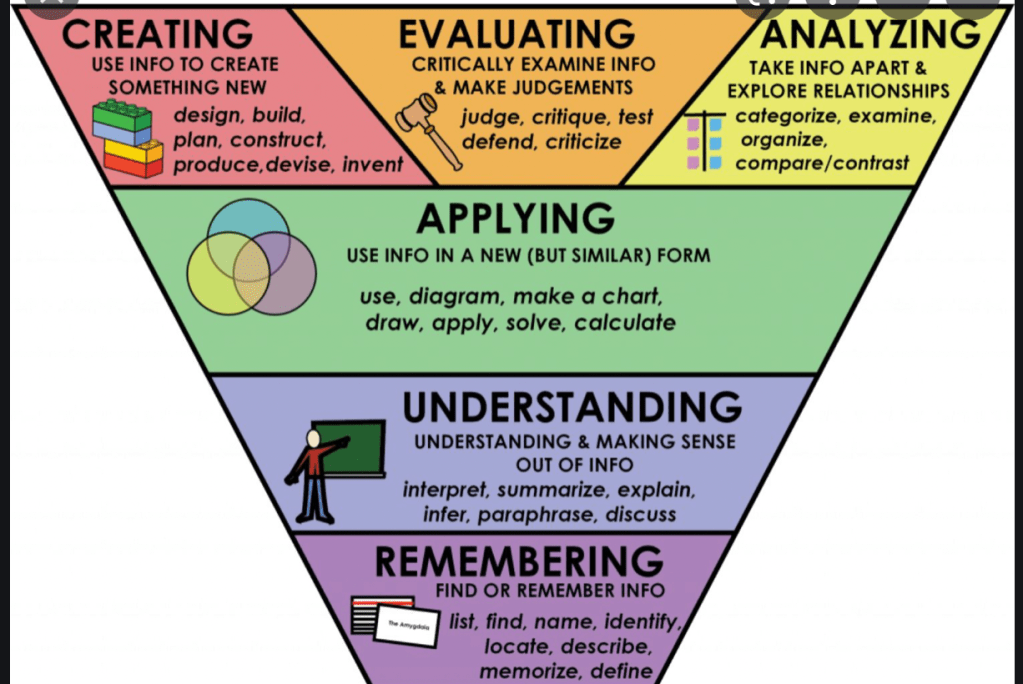
In my fourth year I had a group deep into the book and I was using a new teaching method. At first I handed out a worksheet that had vocabulary words listed at the top of the paper followed by comprehension questions. As I wanted to justify my classroom as gifted education, the questions were not simple comprehension questions that checked to see if the student had read the chapter. Instead the questions were much higher up on the Bloom Scale of Learning. I had made a chart for the classroom so the students could refer to it when I would ask where any activity landed on the chart. The bottom of the scale was just memorizing, locating and describing. I wanted them to aim for the highest levels where creating, evaluating and analyzing were located. A simple read through the chapter would not suffice and thought had to be put into each question.
The usual vocabulary and questions were becoming stale so I introduced a circle group format. As the students sat in the discussions circle, I quickly wrote down their names. I then opened the circle for discussing the chapter in question. Every time a student made an excellent point on the character development, symbolism or plot twist, I would put a mark by their name. I started off discussions with a question or two but I found that they took off with this approach. There was rarely a lull in the discussion. At the end if a student had contributed at least three good points, they were given credit for the chapter and could go one on without completing the dreaded chapter worksheet. There were some students who, for whatever reason, had to finish the worksheet but the majority rose to the occasion. I encouraged them to bring notes and use sticky notes to help them in the discussion. They outdid themselves and I ended up with less correcting and I think the students ended up doing more work to get out of some work.
Into this atmosphere I was informed that some middle school teachers wanted to observe me teaching the book “The Yearling” because they did not believe these ten year old gifted students could understand such a challenging book. The day before the visitation, I informed the class we would have some visitors the next day during reading discussion groups.
The day arrived and before the morning was done, we had five visitors. Several of the teachers even had clip boards. I had the Yearling group gather on the rug and get out their novels and notes. The rest of the class was busy with plenty of work and they knew better than to cause any disruption. I asked the group if anyone wanted to share what was developed with this new chapter. Various students pointed out some character and plot developments. When there was a lull I asked a question about the character, Buck Forrester. The Forresters were next door neighbors to the main characters and were quite rowdy and dangerous. There were a bunch of rough brothers and a very sickly younger brother named Fodder Wing. Fodder Wing and Joey were great friends. The question I asked was about Buck Forrester and if they thought Buck was capable of some despicable act. Quickly one of the students jumped in and said we couldn’t reasonably guess because the character had not been developed enough. He was only two dimensional as opposed to Jody’s father, who had been tested and proved his many faceted character.
Out of my peripheral vision I saw the visitors look at each other in amazement. I think the fifth graders had more than proved they were capable of handling “The Yearling.” At least they came to observe though I believe it was to shut me down with certain topics. Some of them would have to adjust. Part of being an effective teacher is to be flexible.
Those six years at Henderson were exciting and challenging. I hated to leave but that is another story. I wanted every day to be a challenge and somehow exciting. I kept changing each year so I could adjust to each new class. I certainly do not have the energy to even imagine doing that kind of teaching again. Hopefully there are new teachers crazy enough to rise to the challenge and provide the energy needed.
1428 words
3/5/22
 Swagerty-Aldrich Family Web Site